
Aurascape Launches the AI Security Platform for the Agentic Enterprise
Introducing the new Zero-Bypass MCP Gateway on a platform that secures the AI your employees use and the AI your teams build.
March 17th, 2026
The First Wave of AI
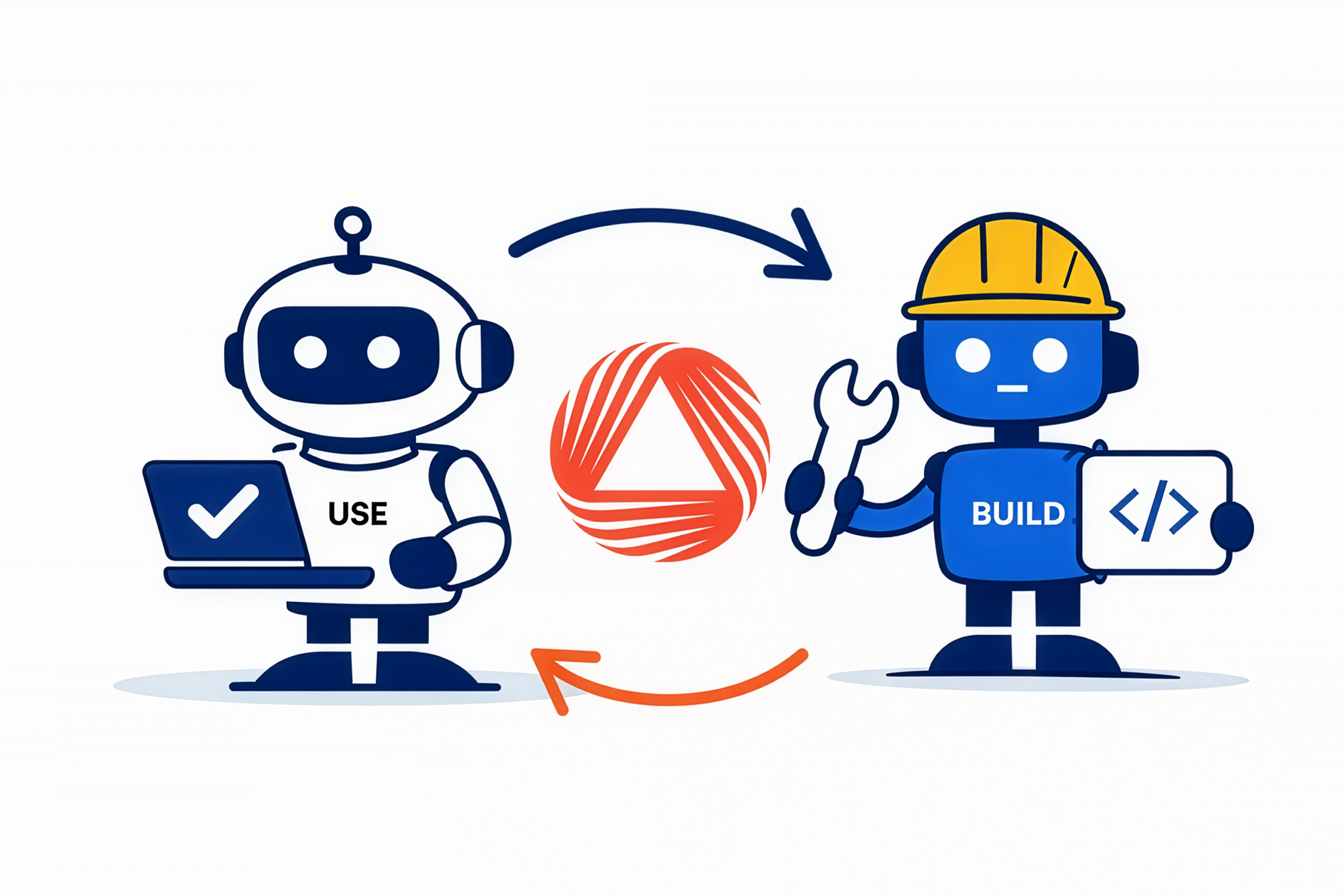
Enterprise AI risk began with employee use. Security teams had to figure out how to govern public AI apps, then AI embedded in business tools, and now increasingly AI agents that can browse the web, read files, connect to enterprise systems, and take action on a user’s behalf. Sensitive data started moving into AI systems faster than policy could keep up, and security leaders needed a way to enable AI adoption without losing visibility or control.
Aurascape was built to solve that problem. We help organizations secure AI use across the three AI surfaces that matter most in the enterprise today: commercial AI, embedded AI, and agentic AI. That means giving security teams broad visibility and consistent control over how AI is being used across browsers, desktop apps, CLI tools, websites, SaaS applications, IDEs, and agentic workflows. It means understanding not just that AI is present, but what data is being shared, what risks are emerging, and what policy should be enforced in real time.
The Next AI Wave Brings New Challenges
But the challenge has now expanded. Organizations are no longer just using AI. They are building AI applications and AI agents that can access tools, retrieve data, generate code, and operate across real workflows. Once AI begins connecting to enterprise systems and taking action, the security problem changes. Security teams now need to govern not just what users ask AI, but what AI can access, what it can execute, what it can expose, and what it can do once it is connected to the enterprise.
This is where many current approaches fall short. Most of the market still treats AI security as separate categories: one tool for AI usage control, another for MCP gateway enforcement, another for testing, and another for code risk. But agentic AI does not operate in isolated layers, and siloed products do not create a real control model. Each may inspect part of the problem, but none can carry trust, context, and enforcement across the full reasoning-to-action path.
That weakness becomes especially clear with MCP. A standalone MCP gateway can only govern the traffic explicitly routed through it. It may help secure approved MCP server access for sanctioned deployments, but it does not solve the broader enterprise problem. Unsanctioned agents, embedded AI features, local agents, and cloud-hosted tools can still use MCP-related execution paths outside the approved flow. If that traffic never reaches the gateway, it is not governed by the gateway. For a CISO, that means the control can look stronger on paper than it is in practice.
A Zero-Bypass Control Model for Agentic AI
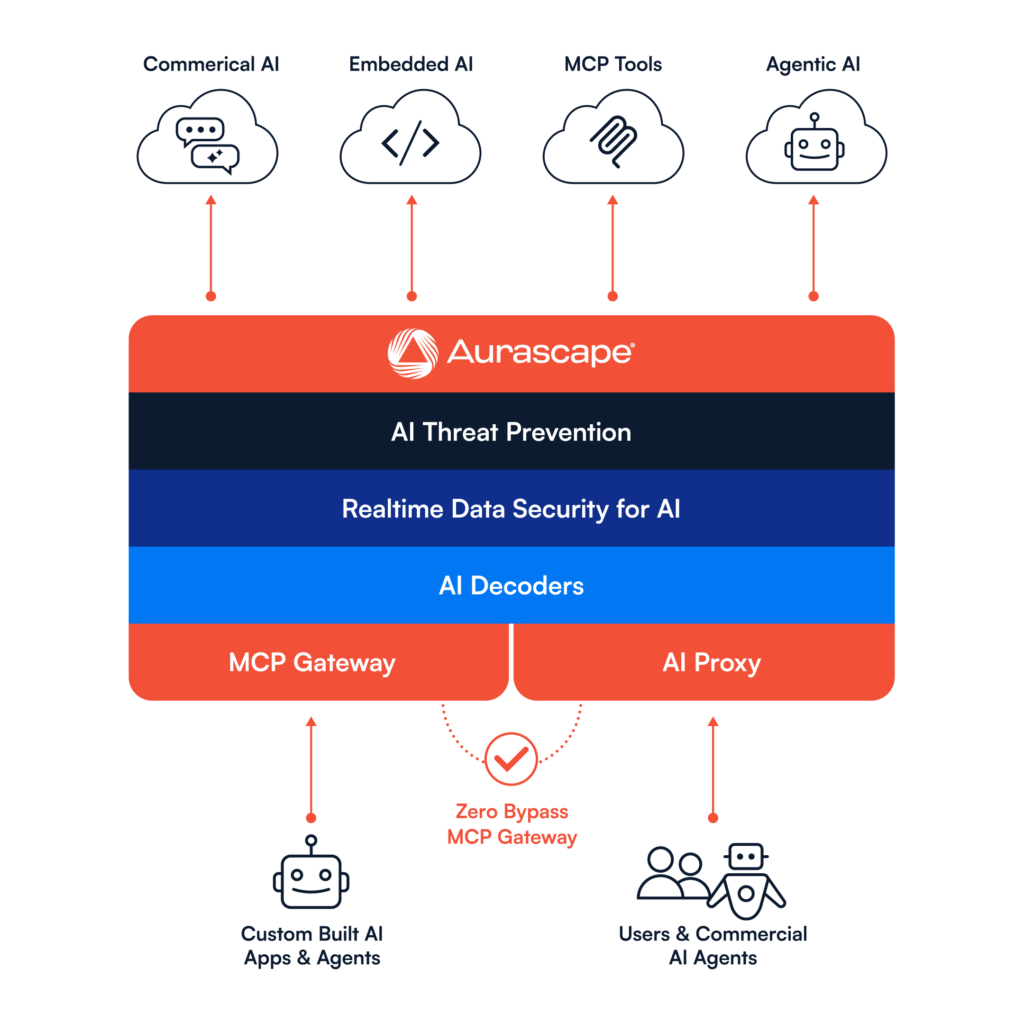
Aurascape addresses that gap directly with the Zero-Bypass MCP Gateway. Aurascape delivers this by combining the Aurascape MCP Gateway and the Aurascape AI Proxy into one continuous enforcement architecture. The gateway governs approved MCP server access and trusted tool use. The proxy secures the model side of the interaction and verifies trust across MCP-related activity visible to the platform. Together, they create a stronger control model for approved MCP tool use while helping security teams identify and govern untrusted MCP-related activity visible to the platform.
That matters because agentic AI now operates across two channels at once: the intelligence channel, where the model reasons and decides what to do, and the tool execution channel, where the agent reaches out to systems, invokes tools, and takes action. Security teams need visibility into both. Aurascape helps provide that by connecting model-side visibility and policy enforcement with governed tool execution through the gateway. It can evaluate what the agent was asked to do, what tool it attempted to invoke, what parameters were used, what came back in the response, and whether that interaction should be allowed, blocked, or sanitized.
Securely Build and Run AI Apps & Agents
Aurascape now adds the core capabilities organizations need to secure how AI is built and how agentic systems operate in production. Aurascape now provides discovery of MCP servers and tool calls, giving security teams direct visibility into the systems agents can reach, the tools exposed to them, and the actions they are attempting to take.
Before release, Aurascape helps teams test custom AI applications and agents to uncover weaknesses, validate behavior, and identify risks before deployment. After release, Aurascape protects live AI interactions with guardrails against toxic or unsafe outputs, jailbreak and role-play bypass attempts, prompt injection and instruction override, code injection via LLM completions, misinformation, and policy violations. Aurascape also adds Code Path and CVE Detection so teams can identify exploitable weaknesses in the code, dependencies, and surrounding application logic that support those AI systems.
And with the Aurascape MCP Gateway and MCP tool signing as part of the Zero-Bypass MCP Gateway architecture, organizations can enforce trusted tool use in production and prevent unsafe or unsanctioned execution paths from slipping past disconnected controls.
What matters is not just each individual capability, but how they work together on one platform. Security teams can now see how agentic systems are connected, test them before release, protect them in production from unsafe interactions and outputs, identify implementation weaknesses around them, and enforce policy once they are live. That gives CISOs a more practical way to govern custom AI applications and agents across the full lifecycle without relying on a patchwork of siloed tools. It also gives them something equally important for operations and compliance: a fuller, more auditable record of how AI systems behave, what they attempted to do, what data they touched, and how policy was enforced.
Expanding AI Use Security Alongside Agentic Security
These new capabilities are centered on securing agentic AI and the systems organizations are building, but they also significantly expand the AI use side of the platform. That matters because the same enterprises building AI agents are also dealing with a fast-growing mix of commercial AI apps, embedded AI, browser-based AI, desktop tools, CLI tools, and unsanctioned agents already in use across the business. Customers need to secure both sides of that reality, not choose between them.
That is why Aurascape now adds significantly broader app coverage, with support for tens of thousands of AI apps and counting. It improves the speed and freshness of discovery so security teams can keep pace with how quickly the AI landscape changes. It introduces custom app signatures so customers can identify and govern unique or environment-specific AI tools without waiting for a vendor catalog update. And it adds local agent discovery, which is especially important as more agentic activity moves onto endpoints and into internal environments where it may never appear as normal web traffic.
For security teams, local agent discovery is more than just another visibility feature. It closes an emerging blind spot. Aurascape can now see both agent traffic inline and agent presence on-device, across sanctioned and unsanctioned environments. Whether an agent is running in the cloud or on an employee laptop, the organization can see it, understand it, and govern it. That is a meaningful shift because it extends AI security beyond the network and into the places where agentic behavior is increasingly happening.
The same principle applies across embedded AI. Employees are no longer only using AI in standalone tools labeled as AI. They are encountering it inside the applications they already use every day, from SaaS products and websites to browsers and developer environments. That is why broad visibility and consistent control matters so much. Security teams need to see the AI interaction itself, not just the surrounding application, and they need to enforce policy consistently whether AI appears in a public assistant, an embedded feature, or an agent workflow.
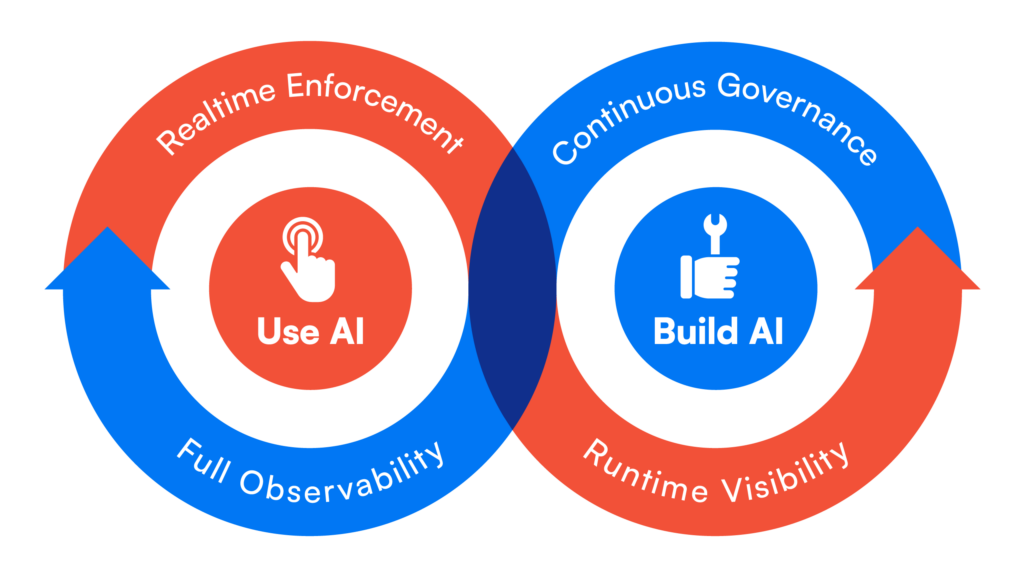
The bigger takeaway is that Aurascape now gives organizations a more complete control model for AI. Aurascape helps customers secure the AI employees use and the AI developers build on the same platform. That means less fragmentation, fewer gaps between controls, and a stronger ability to govern AI from prompt to tool call to execution. Instead of stitching together separate products for AI usage control, MCP governance, testing, and runtime defense, security teams can apply one platform across the full AI environment.
The first wave of AI security was about governing prompts and protecting data. The next wave is about governing access, actions, tool use, and trust across agentic systems. That is the shift Aurascape is built to address.
Conclusion
Aurascape now gives organizations a single platform to secure the AI employees use and the AI developers build. That means broader visibility into AI across the enterprise, stronger control over how agentic systems behave, and fewer gaps between disconnected tools. For security leaders, the outcome is straightforward: a more practical way to govern AI as it moves from interaction to action.
To learn more, watch the on-demand launch event recording.
Aurascape Solutions
- Discover and monitor AI Get a clear picture of all AI activity.
- Safeguard AI use Secure data and compliancy in AI usage.
- Secure Agentic AI Secure how your teams use AI and build AI agents.
- Copilot readiness Prepare for and monitor AI Copilot use.
- Coding assistant guardrails Accelerate development, safely.
- Frictionless AI security Keep users and admins moving.