
Secure Agentic AI
Govern the agents your teams use and build, at the point of action.
Aurascape helps teams adopt AI agents without losing control of what those agents do. It governs the model conversation and gateway-routed tool execution in real time, across the agents employees use and the agents your teams build. Agents can act, without acting outside approved boundaries.
The Challenge
Agents take action, and the security model has to move with them.
Earlier AI responded to prompts. Agents take action. They execute code, read files, reach enterprise systems, and act on an employee’s behalf, autonomously and with delegated or privileged access.
Traditional controls were not built to follow data across multi-step tool chains, stop prompt injection inside a session, or expose vulnerabilities before an agent ships.
Governing what agents do is a security requirement now, not a someday concern.
Most teams do not need another network log. They need to govern what agents do: the models they talk to and the tools they call, before tool actions reach external systems.
Outcomes
Govern agents at the moment of action with full context.

Discover agents in use
Find employee-used agents, agents embedded in SaaS, internally built agents, and shadow MCP servers connected without IT oversight.
Discover and Monitor AI
Govern agent actions at execution.
Enforce policy on the model conversation and gateway-routed tool calls in real time, before tool actions reach external systems.
Read the case study
Block unapproved and unsanctioned calls
Allow marked, approved tools, and block unsanctioned tool calls routed through the gateway.
Read the Whitepaper
Trace data across agent workflows
Follow data across chained tool calls and flag when it crosses a trust boundary.
AI governance and compliance
Test agents before deployment.
Stress-test guardrails with simulated prompt injection and jailbreak attempts, and surface vulnerabilities before agents ship.
Read the product brief
Govern the agents your teams build.
Surface the MCP servers, tool calls, and data exchanges your agents use, and enforce boundaries on agent identity and tool access.
Watch the launch eventAurascape Approach
Two enforcement paths through one gateway.
Aurascape governs agent activity through the Zero-Bypass Agent Gateway, enforcing policy across the model conversation and gateway-routed tool execution before tool actions reach external systems.
Prompts, responses, and instructions are inspected and policy-enforced in real time through the AI Proxy.
Runtime guardrails provide prompt-injection and jailbreak detection, PII filtering, credential guard, code-injection checks, and output sanitization.
Tool calls through the MCP Gateway are verified, signed, and controlled before reaching an external system. Signed tools pass, unsigned calls are blocked.
Agents are stress-tested before they ship, and the gateway deploys in minutes by prepending one prefix to existing MCP server URLs.
What each team gets
Safeguard AI agent adoption
Security, developers, IT, compliance, operations, and leadership each get a different return from governing agents at the point of execution.

Security and CISOs
Governance at the point of execution, where agent actions are inspected and enforceable rather than discovered after the fact.

Developers
Deploy the gateway in minutes and build agents with guardrails and observability, without slowing down.

IT
A custom registry of approved MCP servers and role-based endpoints, with automatic blocking of unsanctioned servers.

Compliance and risk
Audit-ready logs of agent conversations, tool calls, and data exchanges, with data lineage across systems.

Security operations
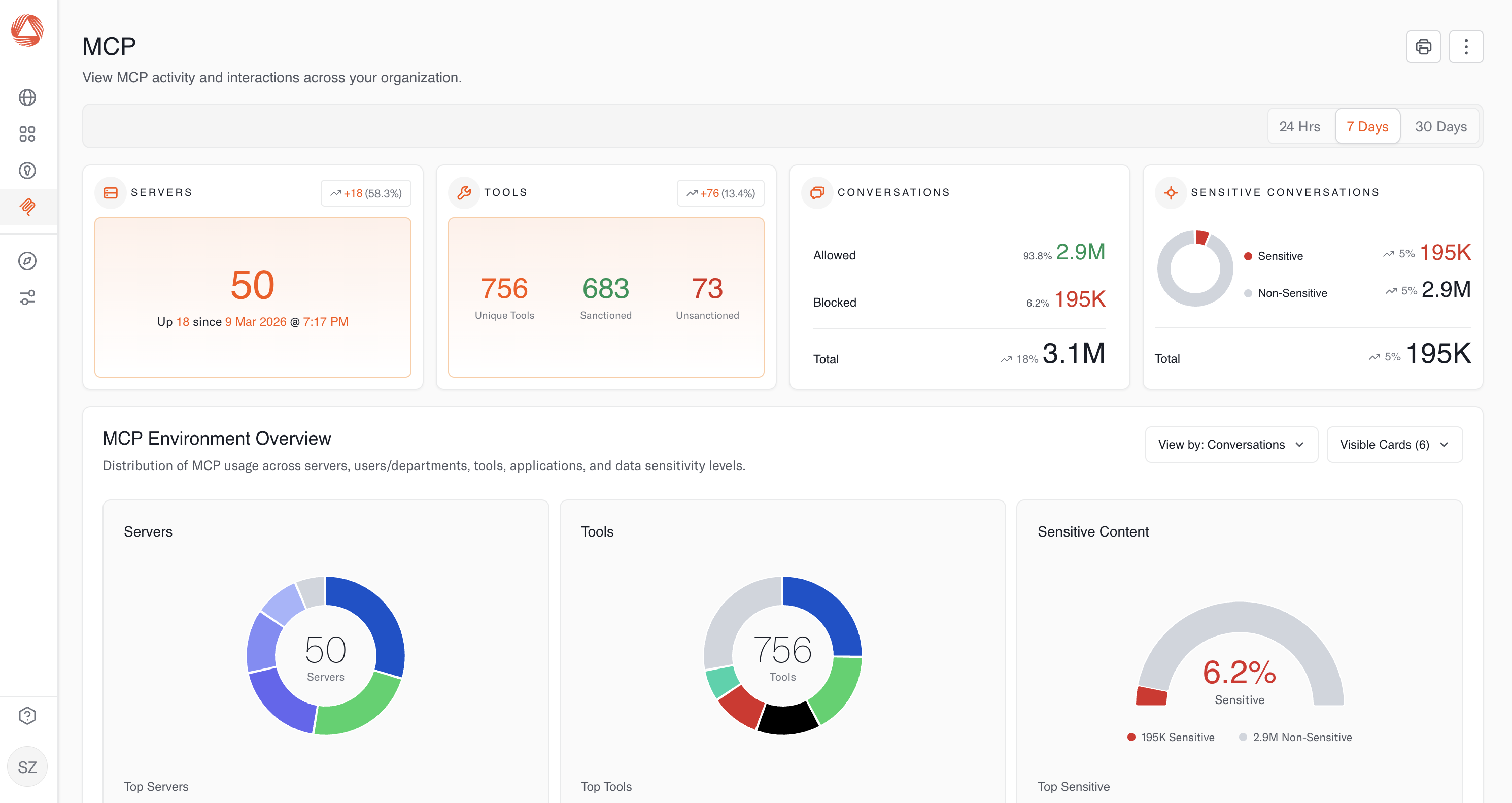
Visibility and control across built, bought, and unsanctioned AI agents, with interaction-level forensics for investigating incidents on any governed agent.

Leadership
Natural-language querying of agent activity gives immediate answers about how agents act across the organization and the risk that comes with it.
The Aurascape Difference
Existing controls cannot govern what agents do. Aurascape can.
Aurascape governs agent behavior at the point of execution, across the model conversation and gateway-routed tool calls.

Govern both channels, not just the network
The model conversation and gateway-routed tool calls are each inspected and enforced.

Per-tool verification, not URL allowlists
Gateway-routed tool calls are verified against approved tools, with unmarked or unsanctioned calls blocked by default.

Policy at the point of execution, not after
Policy runs before a gateway-routed tool call reaches an external system, not in a log reviewed later.
FAQ
Common questions about securing AI agents.
Securing an AI agent means governing two separate channels. The first is the model conversation, where prompts, responses, and instructions move between the agent and the model it reasons with. The second is the tool-execution path, where the agent calls tools and reaches enterprise systems. Aurascape applies policy inline to both through a Zero-Bypass Architecture, so an agent’s reasoning and its actions fall under the same policy.
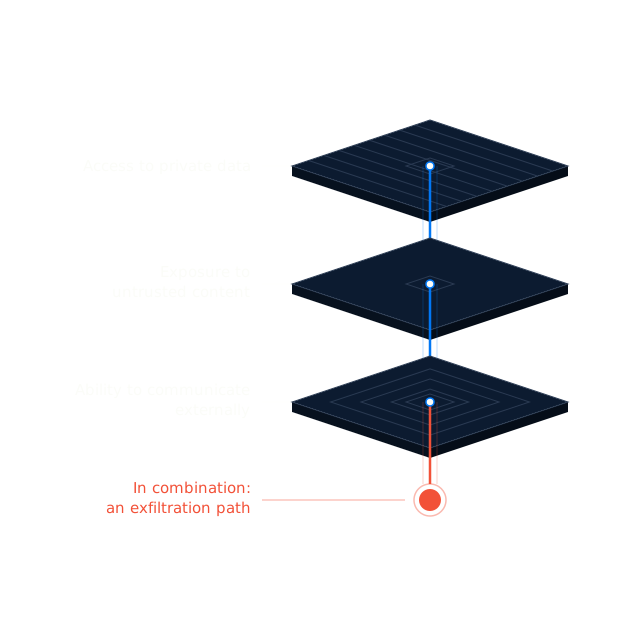
Agents take actions instead of only returning answers, which widens the risk from disclosure to execution. Three ordinary agent capabilities combine into something more dangerous than any one of them alone: access to private data, exposure to untrusted content, and the ability to communicate externally. An agent with those three can become an exfiltration path if its instructions, tools, or context are manipulated, and its blast radius is the sum of the systems its credentials can reach.
Route them through a gateway that evaluates each call before it reaches an external system. Aurascape’s MCP Gateway inspects Model Context Protocol (MCP) tool calls on supported paths, verifies them against approved tools, and blocks unapproved or unsanctioned calls by default. Because the same session’s model conversation is also governed, policy can account for what the agent was asked to do and what it then tried to do.
Tool poisoning hides a malicious instruction inside the description or metadata of a tool an agent can discover at runtime. Models read tool descriptions as direction rather than as data, so a compromised or malicious MCP server can influence what an agent does next without touching the agent’s own code. In governed deployments, Aurascape inspects that exchange and blocks the poisoned tool and the resulting connection before data leaves.
Yes, Aurascape discovers local agents, employee-used agents, agents embedded in SaaS applications, internally built agents, and MCP servers connected without IT oversight. It maintains a catalog of registered servers with their tools, a risk score, and a security scan, and it flags tools it finds operating outside the gateway.
They cover part of it. A secure web gateway and a CASB reason about destinations and channels, data loss prevention reasons about content and known patterns, and that work still matters when agents arrive. What those controls were not designed for is the agent execution path, where an approved destination can carry an impermissible action and the decision has to happen before a tool call lands. Governance built only on destination filtering and log review inherits that gap.
Aurascape surfaces the MCP servers, tool calls, and data exchanges an internally built agent uses, and enforces boundaries on agent identity and tool access. Agents can also be stress-tested with simulated prompt injection and jailbreak attempts before release, so weaknesses surface before production. For developers, the gateway deploys by prepending one prefix to existing MCP server URLs, so adoption does not require rewriting the agent.
Aurascape keeps an audit-ready record of agent conversations, tool calls, and data exchanges, with data lineage showing where information moved across systems. That answers which agent acted, on whose behalf, which records it touched, and what it did next, including MCP activity. In governed deployments the record is built as the activity happens, so it does not have to be reconstructed from separate logs afterward.
Adopt agents without giving up control of what they do.
See how the Zero-Bypass Agent Gateway governs the model conversation and tool execution at the point of action. Book a demo to govern the agents your teams use and build.