
AI Governance and Compliance
Move from AI policy to enforceable AI governance.
Aurascape helps organizations govern the AI their teams use and build by discovering AI activity, enforcing approved tools and policies, protecting sensitive data, and preserving audit-ready evidence.
The governance gap
AI governance fails when policy cannot see the interaction.
Employees use public AI apps. SaaS applications embed AI features. Developers rely on coding assistants. Copilots surface sensitive business data. Agents call tools and take action. Static policies, committee reviews, and spreadsheet inventories cannot see or keep up with what happens inside these interactions.

AI governance only works when it can be enforced at the point of use and build.
Aurascape closes that gap. It gives governance, security, and compliance teams a way to see AI use, classify risk, enforce approved tools and policies, guide users, control agents, and preserve evidence, so policy turns into control.
Coverage
Govern AI across use, build, and agent workflows.

Shadow AI governance
Surface unsanctioned and newly emerging AI tools in use, and bring them under the same approval, policy, and evidence requirements as sanctioned tools.
Discover and Monitor AI
Approved app, tenant, license, and model enforcement
Enforce which apps, tenants, licenses, and models can be used with enterprise data on supported paths.
Learn More
Sensitive data protection
Detect and control risky movement of confidential data, source code, credentials, customer information, and regulated data through AI.
Safeguard AI Use
Copilot and embedded AI readiness
Prepare Microsoft 365 Copilot and embedded SaaS AI by finding overshared data, risky access, and governance gaps before rollout.
Copilot Readiness
Coding assistant governance
Govern AI coding assistants with controls for code, secrets, commands, licenses, models, and tools.
Coding Assistant Guardrails
Agentic AI and MCP governance
Govern agents as they move from conversation to action, including MCP activity, tool use, delegated permissions, and risky actions.
Secure Agentic AIPolicy to Controls
Turn AI governance policy into enforceable controls.
Governance requirements become Aurascape controls applied at the point of use and build.
Discover AI use across apps, copilots, coding assistants, and agents.

Classify apps and interactions by data, context, and action.

Enforce approved tools, tenants, licenses, and models on supported paths.

Coach users in the moment toward the approved path.

Block or redirect risky actions before they complete in governed deployments.

Preserve evidence for audits and investigations.

Distributed governance
Built for distributed governance.
AI governance is not only a security function. Security owns global control, but legal, compliance, HR, data owners, and business units all hold decision rights over how AI is used in their domains.
Aurascape lets those teams participate in governance without turning every decision into a security ticket.

Security
Owns global policy, enforcement, and control across AI use and build.

Legal
Sets handling rules for regulated and contractual data in AI.

Compliance
Monitors AI use against regulatory and internal requirements.

HR
Guides acceptable AI use for the workforce.

Data owners
Define what data can move through which AI tools.

Business units
Request and approve AI tools for their own workflows.
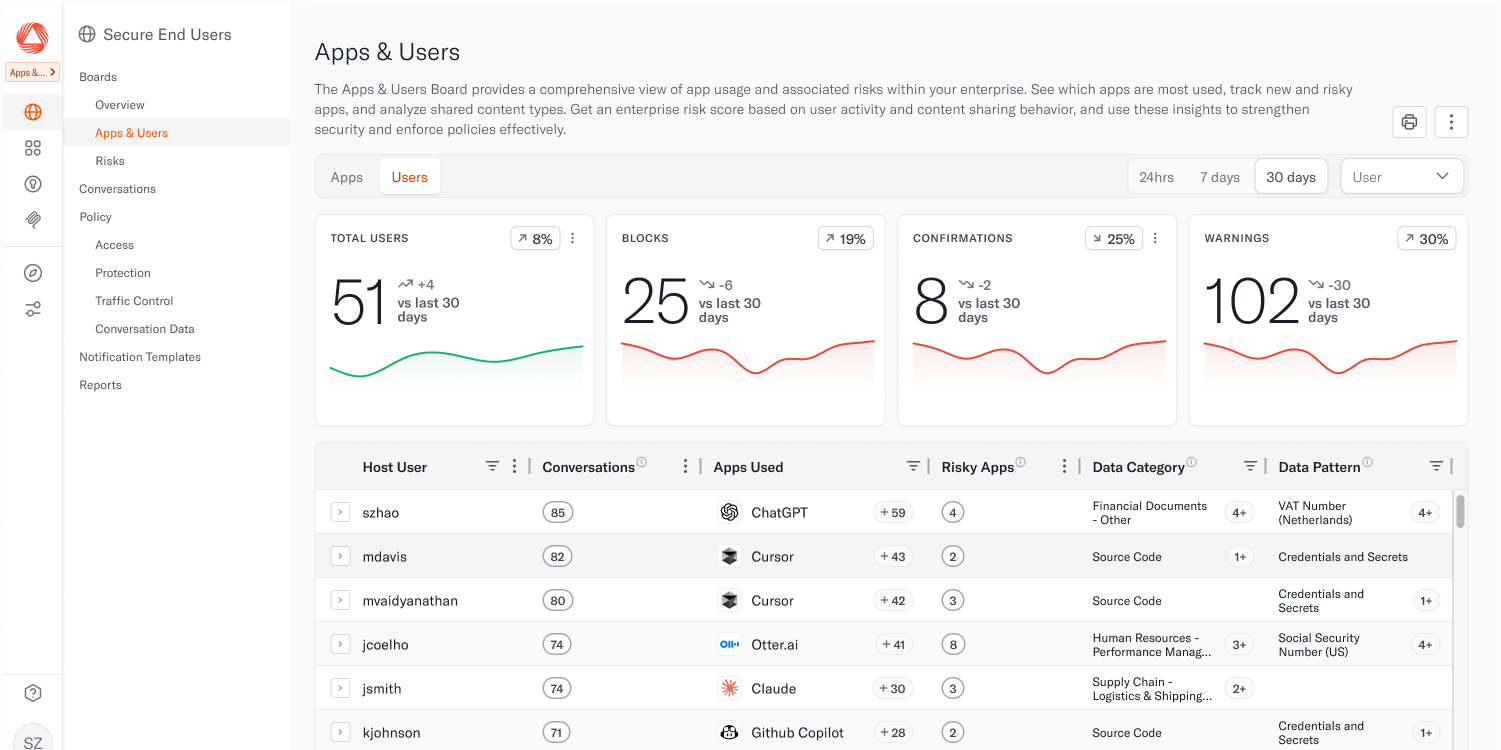
Evidence
Audit-ready evidence for every AI interaction.
When a question comes from an auditor, regulator, or investigator, Aurascape preserves the record needed to answer it.

Who used AI
The user and context behind the interaction.

What tool was used
The AI app, copilot, coding assistant, or agent involved.

What data was involved
The sensitive or regulated data in the prompt, upload, response, or generated code.

What policy applied
The governance policy evaluated for the interaction.

What action was taken
Whether the activity was allowed, coached, or blocked.

What happened next
The action the AI or agent took, including tool and MCP activity.
FAQ
Common questions about enterprise AI governance.
Enterprise AI governance is how an organization sets and enforces rules for how AI is used and built, including which tools and models are approved, what data can move through them, who can use them, and what evidence is kept. It spans employee AI use, copilots, coding assistants, and agents, not only a written policy.
An AI governance framework defines rules, roles, and requirements. Aurascape helps enforce those requirements at the point of AI use and build by discovering AI activity, applying policy, guiding users, controlling risky actions, and preserving evidence.
Aurascape connects policy to the point of use and build. It discovers AI activity, classifies apps and interactions, and enforces approved tools, tenants, licenses, and models on supported paths, so a written policy becomes an applied control rather than a document.
Aurascape records AI activity and the policy decisions applied to it, giving compliance teams an ongoing view of which tools are used, what data is involved, and which actions were allowed, coached, or blocked, with evidence available for audits and reviews.
Aurascape surfaces unsanctioned and newly emerging AI tools in use across the enterprise, so security teams can bring shadow AI under the same approval, policy, and evidence requirements as sanctioned tools.
Aurascape preserves audit-ready records of who used AI, what tool was used, what data was involved, which policy applied, what action was allowed, coached, or blocked, and what the AI or agent did next.
Aurascape governs agentic AI as agents move from conversation to action, including MCP activity, tool use, delegated permissions, and risky actions, applying policy before an agent reaches an external system on supported paths.
Make AI governance enforceable.
See how Aurascape turns AI policy into controls and evidence across employees, applications, copilots, coding assistants, LLMs, and agents.