
The AI Traditional Security Tools Cannot See
Traditional security tools recognize AI by its URL and miss the accounts, the data, and the AI that never touches a browser. What full AI visibility means, and the report it produces.
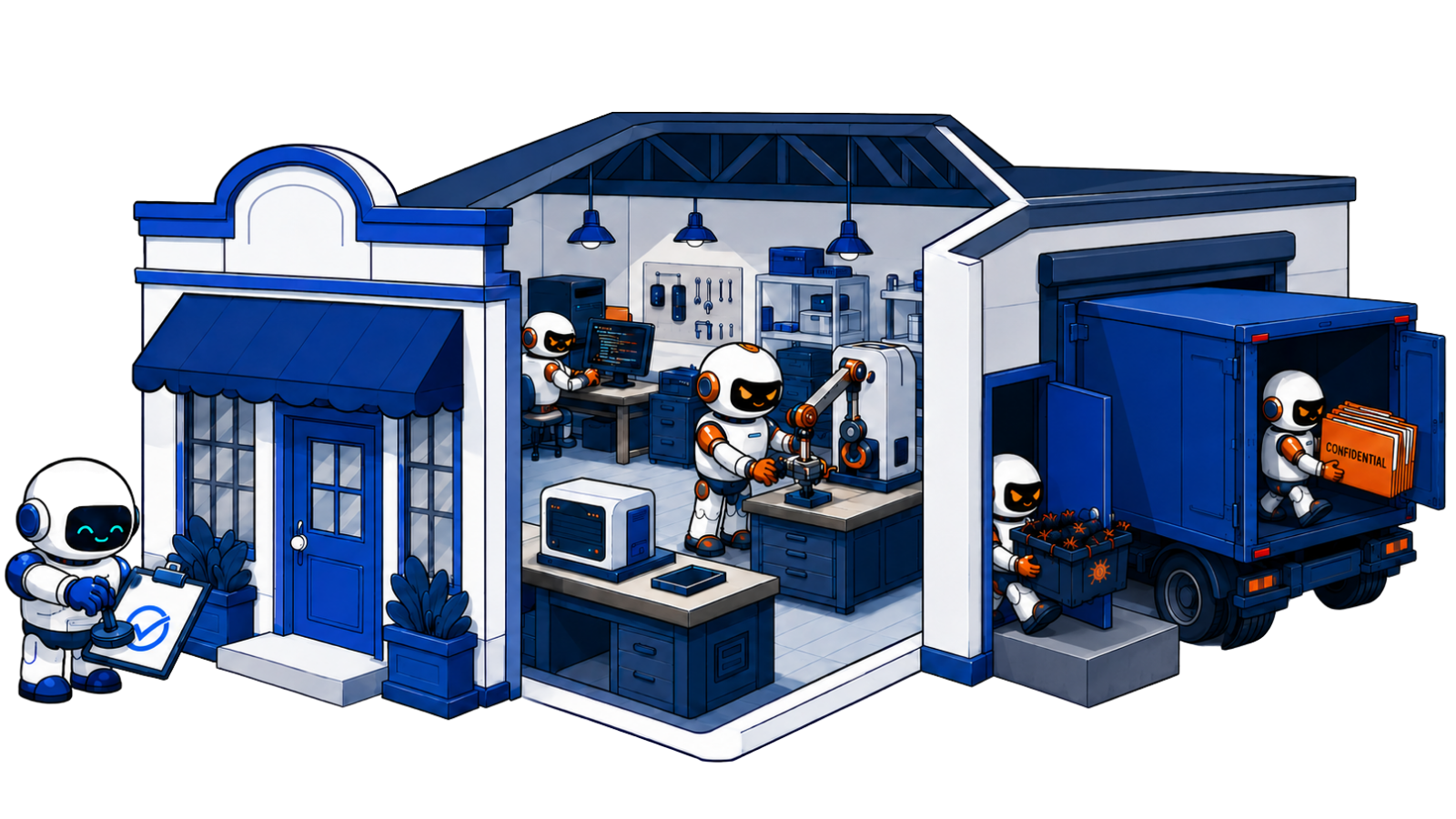
Mark McLaughlin, Product Marketing Manager | Aurascape
September 2nd, 2026 | 🕐 6 minute read
Introduction
Most organizations today have a list of their approved AI tools. A committee reviewed each AI vendor, security dug into the risks, legal read the terms, and someone negotiated enterprise licenses. Traditional security vendors state they secure this list and lock down tools not on the list: the web gateway categorizes AI sites, the dashboard shows an AI app list, and traffic to unapproved tools should be blocked.
That picture is a false sense of security. Traditional security tools recognize AI by destinations, because that is what they were built to do. They can tell you an employee reached an AI site. They cannot tell you which account they accessed the AI tool with, what the tool can do, what data went into it, or which threats came back. For AI, that gap is where the risk lives.
The problem is also bigger than any list. AI does not only appear as standalone websites. It shows up as web apps, as features inside trusted SaaS apps, as coding assistants inside developers’ IDEs, as desktop clients, as API integrations, and as agents that act on their own. A list of approved destinations cannot describe this interconnected world.
Discovery must be able to see and understand all these AI surfaces and their connections. It should find new AI as it appears, learn what each tool can do, score its risk, keep re-scoring as the facts change, and monitor its activity within guardrails. This is what Aurascape’s Discover and Monitor AI solution does.
The questions traditional tools cannot answer
Consider a common scenario. The board of a bank asks its CISO a fair question: where is AI being used in this company, and is client data going into it?
The CISO has their security tools: the secure web gateway has a dashboard of AI destinations. The CASB has an app list. The reports look complete. But they answer a different question than the one the board asked.
Those tools see the URL, so they can report that 400 employees reached a popular AI assistant last week. They cannot say whether those employees signed in with the enterprise tenant the bank licensed or with personal free accounts, which matters because the bank’s data residency requirements are only met in the enterprise tenant. They cannot say whether an underwriter pasted loan documents into the chat or asked for help wording an email. They miss the AI feature that switched on inside the CRM last month, because that traffic looks like ordinary SaaS use. And they fail to find the coding assistant running in a developer’s terminal, which never touches the browser.
So, the answer to the board is an estimate. Security teams know it. It is part of why organizations assessing AI-tool security before deployment nearly doubled, from 37% to 64%, in the World Economic Forum’s 2026 cybersecurity outlook.
Bolted-on AI visibility falls short
Traditional security platforms now ship AI features. Most produce an inventory of AI apps from URL and domain data, because that is what their engines read. They cannot resolve which tenant an interaction ran under, what the user or agent did inside the tool, or what data moved. Browser-only discovery misses even more, because AI also runs in desktop clients, IDEs, command-line tools, and local AI agents.
The acceptable AI use policy runs into the same wall. The policy sets expectations. Measuring whether the workforce follows it takes visibility the traditional stack cannot produce. Adherence becomes an assumption, through no fault of the team that wrote the policy.
There is no need to rip out every security tool. The existing security stack is quite good at securing ordinary, non-AI traffic. The gateway, the SASE stack, and the use policy keep doing jobs that matter, and AI-specific visibility is additive to them.
What full visibility means
Full visibility for AI means you can see four components of every interaction:
- The app: Which AI tool this is, not which site carried it. That includes shadow AI, Embedded AI, and agentic AI: the unsanctioned standalone tool, the AI feature inside licensed software, and the agent acting through APIs and MCP tool calls.
- The account: Whether the interaction ran under the approved enterprise tenant or a personal account. Enterprise plans can carry negotiated terms around training and retention. The identical app under a personal login sits outside those terms. The same prompt can be routine on one account and a data exposure on the other.
- The intention: What the tool was asked to do. Aurascape calls these Intentions: chat, file upload, code generation, browsing, connectors, tool calls, and many more. A low-risk question and a high-risk upload travel to the same destination. Telling them apart takes intention-level visibility.
- The risk: What the interaction exposed, read against the risk profile of the application behind it.
Aurascape understands all four, because it inspects the AI interaction itself. It sees AI activity wherever it occurs: inside web apps, SaaS features, desktop clients, IDEs, command-line tools, APIs, and agents. It finds and surfaces activity from local AI running on devices. Finding an AI app in your environment is step one. Seeing what a user or agent did inside it is what makes full visibility and control possible.
An AI inventory that does its own research
New AI tools launch every day; Aurascape has detected 50 or more releasing daily. Discovering, researching, and writing policy for every one of these new tools would require a dedicated team. Aurascape automates this process for you. Its patented AI discovery and risk analysis engine crawls the web for newly launched AI tools, reads what each vendor publishes, checks for breaches, scans CVE and vulnerability feeds, and scores risk with an ensemble of task-specific models. The catalog covers 30,000+ AI applications, and an app is often scored before the first employee opens it. For apps that are not, Aurascape commits to a 48-hour SLA from customer request to app support.
Every application carries a risk profile: category, model and mode, entitlement tier, and 25+ risk attributes covering the app’s privacy posture, data handling, terms of service, security posture, breach history and more. Vendors change their terms, their models, and their data practices, so scores are continuously refreshed. The risk profiles stay current. You can find the scoring methodology here.
Your own AI counts too. Organizations can bring their custom-built AI apps into the inventory, along with subscription AI tools the catalog treats as theirs, through customer-driven signatures. The process to bring your own app into your AI catalog is simple, with multiple options to create a signature and apply policy. An internal assistant your team built, or a niche tool your business depends on, gets the same discovery, scoring, and policy as everything else.
Some AI never touches the network at all: a local model on a data scientist’s laptop, or an AI agent a developer installed on their device. Aurascape’s optional endpoint agent finds this class of AI through process and filesystem analysis, so the inventory covers the AI running on machines as well as the AI reached over the wire.
The benefit for the security team is a review queue that finally shrinks. Choose to incorporate new apps within risk score ranges into existing policy, or use tags to group apps by category. Nobody needs to research every new AI tool.
Monitor AI activity
The catalog answers which AI exists. Monitoring ensures AI activity stays within guardrails.
Because Aurascape reads the interaction itself, security teams see usage at the level where risk lives. Dashboards and reports show the overall picture. When an investigation calls for it, an analyst can open an individual conversation and read it end to end, prompt and response, with the reason a policy fired attached. File uploads, pasted source code, and regulated data are recognized and categorized in motion across hundreds of data categories, themes, and topics. Threats are also categorized by their threat class, including types of prompt injection, jailbreaking, and specific file types for malware detection.
Entitlement monitoring answers both a budget question and a risk question. Discover when people access sanctioned tools through personal accounts while the enterprise seats the company bought go unused. Turn on real-time coaching for users, nudging them to access the sanctioned tool with the correct account to simultaneously reduce unused seats and risk.
The same visibility covers AI agents. As agents begin to automate business processes, interaction-level monitoring follows what the AI did, not just which domain hosted it. Organizations building or running agents get full visibility and monitoring for those agents’ actions.
All of it becomes evidence. Usage, policy adherence, and risky behavior are preserved for audit and investigation. When the examiner or the board asks how AI is governed, the answer comes from records. A security analyst gets the why behind an alert. A compliance officer gets adherence records. IT gets entitlement. Leadership gets adoption and risk trends.
The first deliverable: a report of all AI activity
The first thing customers get is a comprehensive report of AI activity across the organization: which tools are in use, sanctioned and not, under which accounts, with what data moving into them, and actionable recommendations for reducing the risks it surfaces. Shadow AI stops being a suspicion and becomes a list of discovered AI tools, each with access and usage statistics.
What happens next depends on where you start. A company without an AI use policy now has the material to write one grounded in observed use: the tools people already rely on, the risks that showed up, the sanctioned alternatives worth licensing. And because Aurascape stays in the interaction path, enforcement is ready the moment the policy is written.
A company that already has a policy gets the measurement most teams have been missing: adherence as observed fact, user by user, tool by tool. Closing gaps happens gradually. Coach users in the moment toward sanctioned tools and enterprise accounts. Block the riskiest actions, with real-time explanations and approved alternatives for users. The initial report gives you the foundational source of truth you need to build security policy that works for your users.
A week with the full picture
Here is an example week with the visibility that Aurascape provides.
On Monday, a new AI image-generation tool goes viral. It is already in the catalog with a risk profile, so when the first employee opens it, it shows up in the inventory, scored, with the interaction visible. A prompt containing a paste of sensitive data is blocked, while safe usage goes uninterrupted.
On Wednesday, a report shows a group of engineers using the company’s sanctioned coding assistant through personal accounts. The IT team turns on a coaching policy that tells those users to sign in with their enterprise accounts when they work with code. No escalation, just specific evidence and a fix delivered in the moment.
On Friday, the AI governance committee meets. The massive backlog of unreviewed tools is gone. The committee reviews the 3 new AI tools requested by employees that week, checks the risk scores using Aurascape, and decides to purchase licenses for one tool while turning on Aurascape policy to coach users away from the other 2.
Security and IT teams get a clear view of all AI activity and its risks, and Aurascape provides the inline controls to act on what they see with real-time policy.
Proof from regulated enterprises
A Fortune 500 healthcare enterprise secured AI use across 60,000+ users, with the long tail of unsanctioned tools brought under control. A Fortune 500 insurer was 60% faster to adopt, with 28,000 AI uses protected while adoption accelerated. And The Police Credit Union, a regulated financial institution answering to NCUA examiners, built its AI compliance posture on the same visibility-first sequence.
To govern AI, start with the full picture
Discovery and monitoring are where AI security starts, not where it ends. Once an organization sees its AI use with real resolution, it’s time to secure that activity: policies that protect data and stop threats in AI interactions as they happen, and governance programs that regulators can inspect.
The results are fast. The next time leadership asks where AI is being used and whether company data is going into it, the answer is a report, not an estimate.
Start with the report. Book a demo today and in 30 days you can see the inventory your own environment produces.
Aurascape Solutions
- Discover and monitor AI Get a clear picture of all AI activity.
- Safeguard AI use Secure data and compliancy in AI usage.
- Secure Agentic AI Secure how your teams use AI and build AI agents.
- Copilot readiness Prepare for and monitor AI Copilot use.
- Coding assistant guardrails Accelerate development, safely.
- Frictionless AI security Keep users and admins moving.
- AI Governance & Compliance Move from AI policy to enforceable governance.